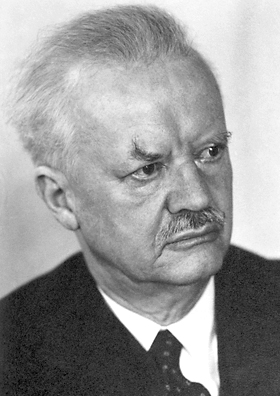
Hans Spemann (1869 – 1941)
Hans Spemann (1869 – 1941) was a German zoologist whose experiments established the importance of interactions among tissues during embryonic development. He studied medicine and natural science at Heidelberg, Munich, and Würzburg, and earned his doctorate under Theodor Boveri in 1895. After appointments at Rostock and the Kaiser Wilhelm Institute for Biology in Berlin, he became professor of zoology at Freiburg in 1919. His laboratory became a major center of experimental embryology
Spemann developed delicate micro-surgical
techniques to investigate how embryos establish their body
plans. His early experiments used a fine hair from his
infant daughter's head to constrict
salamander eggs across several planes, and
demonstrated that the divided embryonic material could
produce twins under appropriate conditions. By transplanting
early tissue from the embryonic eyes, he showed that eyes could be induced
in other areas of the epidermis In the early 1920s,
his doctoral student Hilde Mangold transferred the
dorsal lip of the blastopore between newt embryos whose
pigmentation differed. The transplant induced a secondary
body axis, and the pigmentation differences revealed that
host cells contributed substantially to its tissues. In
1924, Spemann and Mangold published their results jointly in
1924.
Mangold died in an accident later that year: Spemann
received the 1935 Nobel Prize in
Physiology or Medicine for the organizer effect.
The modern name Spemann–Mangold
organizer recognizes her
essential contribution.
In 1938, Spemann published Embryonic
Development and Induction, which
summarized his experiments and interpretations. He also
proposed nuclear transplantation as a test of whether a
nucleus from a specialized cell could direct the development
of an entire organism. That proposal anticipated later
experiments in nuclear transfer and cloning.
Text material © 2026 by Steven M. Carr