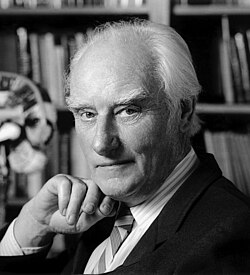
Francis Harry Compton Crick (1916 – 2004)
Francis Harry Compton Crick (1916–2004) was a British physicist and molecular biologist whose research elucidated DNA structure and the relationship between genes and proteins. He received his BA in physics from University College, London, in 1937, and during World War II, worked for the British Admiralty on acoustic and magnetic mines. Inspired like other physicists by Schrodinger's What is Life?, in 1947, he turned to biology at Cambridge’s Strangeways Research Laboratory. In 1949, he joined Max Perutz’s Medical Research Council unit at the Cavendish Laboratory, where he investigated protein structure by X-ray crystallography. In 1954, he completed his Cambridge doctorate, a year after his most famous discovery.
In 1951, while still working on his doctorate, Crick met James Watson, and their complementary interests produced an unusually effective scientific partnership. In 1953, they proposed a structural model of DNA, based on base-pairing between two anti-helical sugar-phosphate strands. Their work was influenced by X-ray crystallographic evidence from Rosalind Franklin, Raymond Gosling, Maurice Wilkins, and their colleagues at King's College. Crick’s expertise in helical diffraction and crystallographic symmetry complemented Watson's insight into complementary base pairing. Their model connected molecular structure with gene replication. Their model appeared in Nature in April 1953, alongside the King’s College papers. In 1962, Crick shared the Nobel Prize in Physiology or Medicine with Watson and Wilkins.
Crick
subsequently helped establish many of molecular biology’s
conceptual foundations. His sequence hypothesis
connected nucleotide order with amino acid order, and his Central
Dogma maintained that genetic information passed only
from DNA to protein, not. v.v. His adaptor hypothesis
suggested the need for an intermediate molecule between DNA
and protein, which anticipated the role of transfer
RNA in protein synthesis. In 1961, Crick and others
supplied genetic evidence for a triplet code, and
his later wobble hypothesis explained flexibility in
codon recognition. In 1977, he began research at the Salk
Institute in California, into the neural basis of
consciousness, particularly visual awareness.