Alexander
Humboldt (1769 - 1859)
Alexander von Humboldt (1769–1859) was a Prussian
naturalist, geographer and explorer. Born in Berlin, he
trained in botany, geology, mining, and surveying methods of
measurement. From 1799-1804, accompanied by the French
botanist Aimé Bonpland, Humboldt undertook a five-year
scientific journey through Spanish America, traveling in
present-day Venezuela, Colombia, Ecuador, Peru, Cuba, and
Mexico before visiting the United States. His Personal
Narrative of this and other travels made him one
of the most famous of 19th century explorers.
As well as collecting thousands of plant
specimens, Humboldt made physical measurements such as
temperatures, elevations, magnetic forces and atmospheric
conditions. By
comparing vegetation at different elevations and in
different parts of the world, he showed that climate and
geography shape the distribution of plants. His
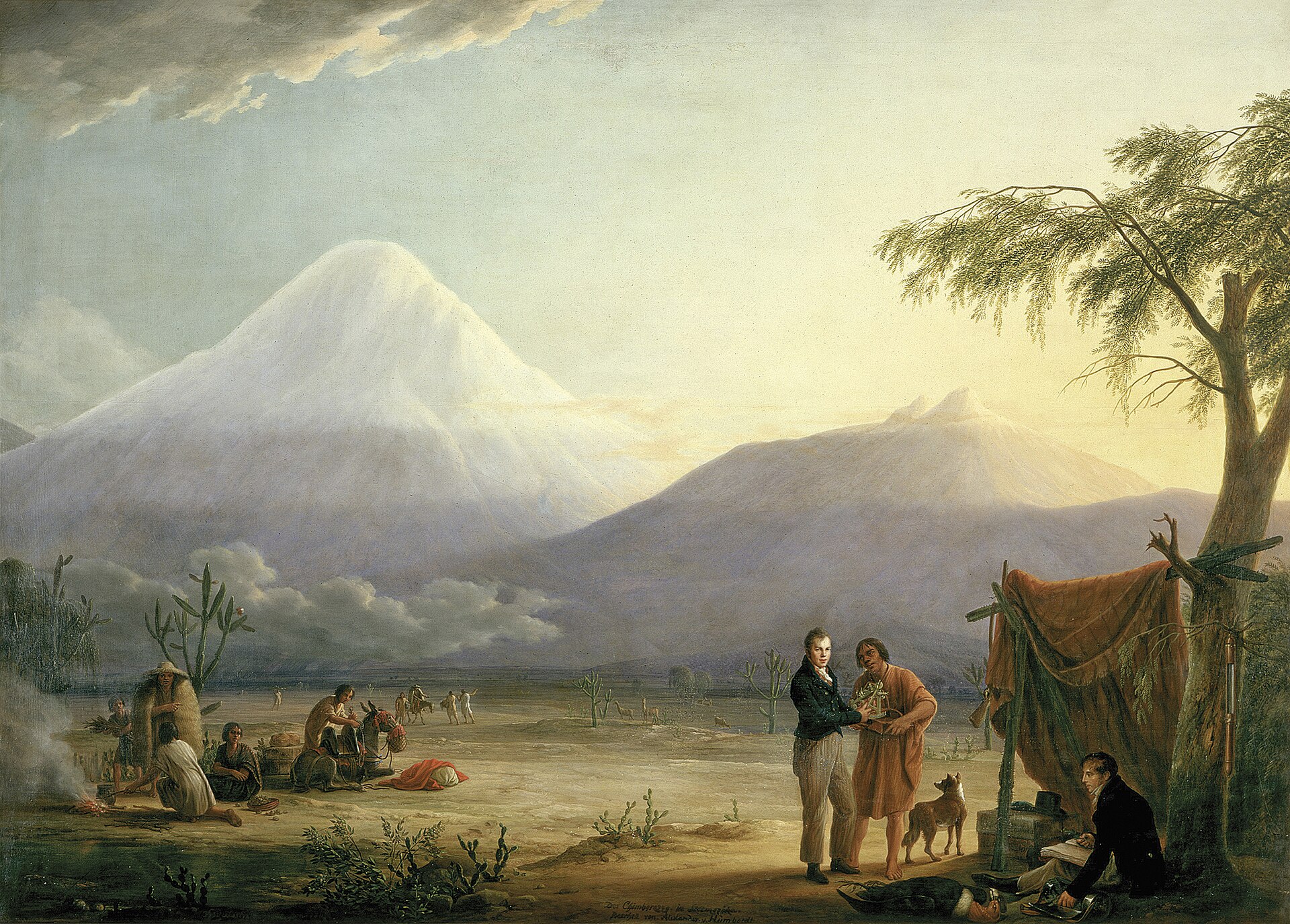
1802 attempt to climb Chimborazo [below, left] in
Ecuador in 1802 took him higher than any recorded European
climber had previously reached. His diagram of Chimborazo of
life zones and plant communities [below, right] remains
famous as one of the first to present a mountain as a
connected ecological system.
He was one of the first naturalists to
observe that human interventions such as deforestation and
irrigation could alter local climates. later life he
attempted to unite the scientific knowledge of his age in
Cosmos, an ambitious description of the physical universe.
His ideas influenced scientists and writers including
Charles Darwin, and his name survives in numerous species,
geographic features and scientific institutions.
His travel books had many readers, including the young Charles Darwin.
Darwin made frequent reference to Humboldt's work in his
own, "Voyage of the Beagle", and his sister
remarked that, by much reading of Humboldt, he had "...
got his phraseology and the kind of flowery French
expressions he uses."
Darwin sent a copy of his Journal
of Researches to Humboldt, who answered, "You
told me in your kind letter that, when you were young, the
manner in which I studied and depicted nature in the
torrid zones contributed toward exciting in you the ardour
and desire to travel in distant lands. Considering the
importance of your work, Sir, this may be the greatest
success that my humble work could bring." Darwin
called Humboldt's "Personal Narrative" one of
the two most influential books on his own work, alongside
Lyell's Principles of Geology.