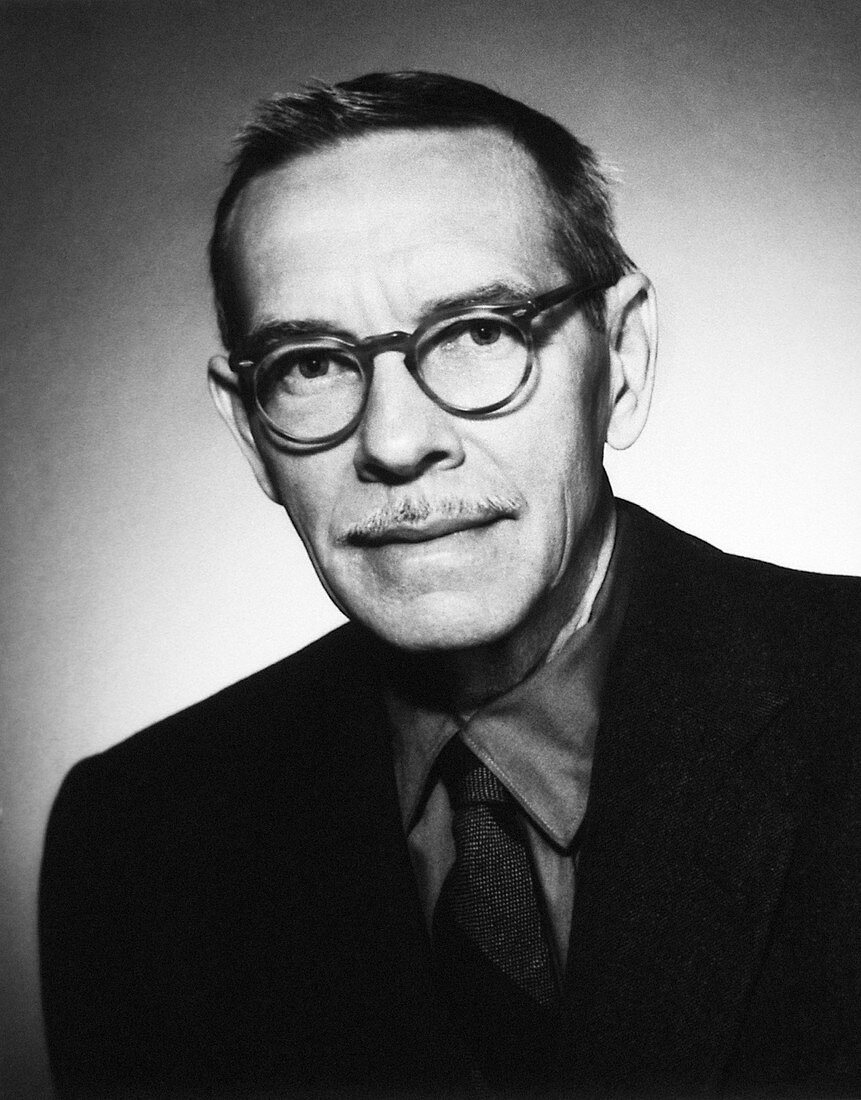
Alfred Day Hershey (1908–1997)
Alfred Day Hershey (1908–1997) was an American bacteriologist and geneticist whose research helped establish DNA’s role in heredity. He was born in Owosso, Michigan, and obtained his doctorate at Michigan State College in 1934. He joined the Department of Bacteriology at Washington University School of Medicine in St. Louis, where he investigated bacteria and bacteriophages, the viruses that infect them. Hershey demonstrated mutation and genetic recombination in bacteriophages, and his work helped make these simple biological systems central to research on the nature of genes. During the 1940s, his exchanges with Max Delbrück and Salvador Luria helped establish the influential Phage Group.
In 1950, Hershey joined the Carnegie Institution of
Washington’s Department of Genetics at the Cold Spring
Harbor Laboratory, New York. In 1952, he and and an
undergraduate summer student Martha
Chase demonstrated that, during the infection of
bacteria by bacteriophage, bacteriophage DNA entered
the bacteria while most viral protein remained outside.
Their results supplied strong independent support for DNA
as the hereditary molecule, thus extending the
implications of Avery, MacLeod, and McCarty’s earlier
research on bacterial transformation. In 1969, he shared the
Nobel Prize in Physiology or Medicine with Delbrück and
Luria for their work with bacteriophage to make fundamental
discoveries concerning viral replication and genetic
structure.