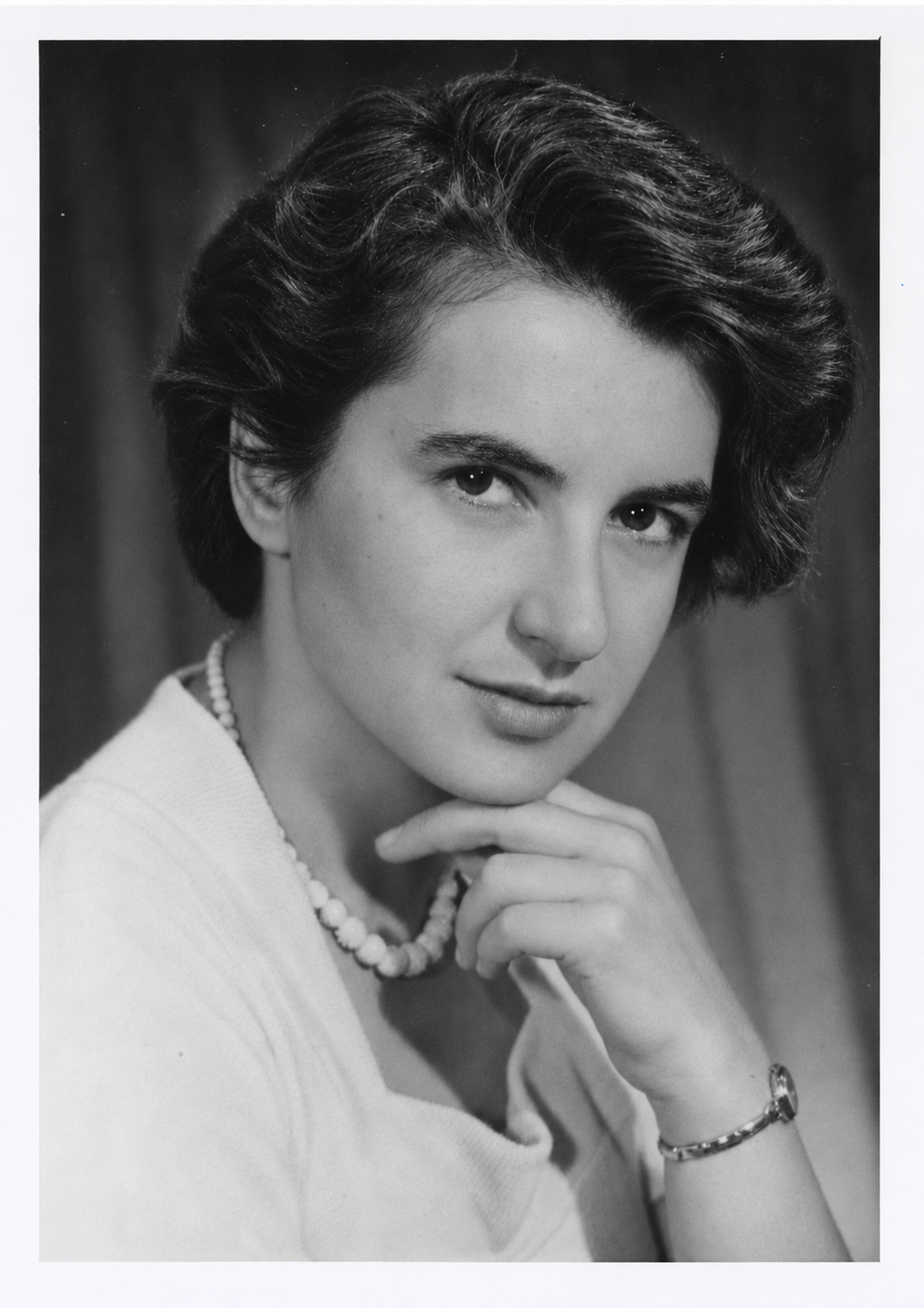
Rosalind Elsie Franklin (1920 – 1958)
Rosalind Elsie Franklin (1920–1958) was a British physical chemist and X-ray crystallographer whose research advanced knowledge of the structure of coal, DNA, and viruses. During World War II, she investigated the physical structure and porosity of coal, for which she received her doctorate at Cambridge in 1945. She further developed her expertise in X-ray diffraction methods in Paris, where she established important distinctions between forms of carbon.
In 1951, Franklin joined John Randall’s biophysics unit at King’s College London. Randall assigned her independent responsibility for experimental X-ray research on DNA. Bernal's failure to clarify this arrangement with the more senior Maurice Wilkins, whose expectations of their relationship differed from hers. With graduate student Raymond Gosling (1926 - 2015), Franklin distinguished the A (dry) and B (wet) forms of DNA, and obtained exceptionally clear diffraction patterns, especially of the crystalline "A" form. In May 1952, their work produced the famous Photo 51 of the "B" form, whose characteristic "X" cross supplied strong evidence for a helical structure, though not necessarily a two-stranded "double helix". Her measurements on the photo, begun in late February 1953, supported Watson and Crick’s model of a base-paired, double-helix. On April 25, 1953, Franklin and Gosling’s paper appeared in Nature alongside papers by Watson and Crick and by Wilkins and his colleagues.
In early 1953, Franklin moved to Birkbeck College, where
John Desmond Bernal supported her independent research on
virus structure. With Aaron Klug and other colleagues, she
investigated tobacco mosaic virus and established the
location of its RNA within its protein
architecture. Her group also extended its research to other
plant viruses and began work on poliovirus. She continued
her scientific work despite ovarian cancer, from which she
died in London at age thirty-seven. Watson, Crick, and
Wilkins shared the Nobel Prize in 1962 for the discovery of
DNA structure; by the terms of Nobel's endowment,
the prize is not given to deceased persons nor to more than
three persons.
Watson's 1968 book "The Double
Helix" painted an unflattering personal portrait
of Franklin, and raised questions about scientific ethics,
assignment of credit, and the treatment of women in science.
Her achievements across carbon chemistry, DNA structure, and
structural virology established a scientific legacy that
extends well beyond the controversy over recognition for the
double helix.