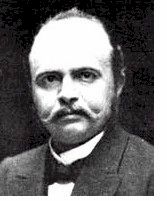
Hans Driesch (1867 – 1941)
Hans Driesch (1867–1941) was a German embryologist and philosopher whose experiments helped establish the concept of Regulative Development. He studied zoology with August Weismann at Freiburg and Ernst Haeckel at Jena. In 1889, he earned his doctorate through research on hydroid colonies. He pursued experimental studies of embryonic development at the Zoological Station in Naples.
His most important experiments concerned early development sea urchins. Driesch separated two-cell embryos at the two-cell stage, and showed that each cell developed as a complete larva, about half the normal size. This result challenged the mosaic model of development, that each early cell made a particular contribution to the future organism. Driesch demonstrated that a cell’s developmental potential could exceed its usual contribution to an intact embryo. His experiments established that early embryos could regulate their development after substantial disturbance, and directed embryology toward direct experimental tests of developmental mechanisms.
Later in life, Driesch concluded
that physical and chemical mechanisms alone could not
explain this capacity for regulation. He proposed an
organizing principle, Entelechy,
that directs organismal development toward a coherent whole,
and he became a prominent advocate of Neo-vitalism.
His pacifism and philosophical views brought him into
conflict with the Nazi regime, which forced his retirement
in 1933. His embryological discoveries retain their
importance.
Text material © 2026 by Steven M. Carr