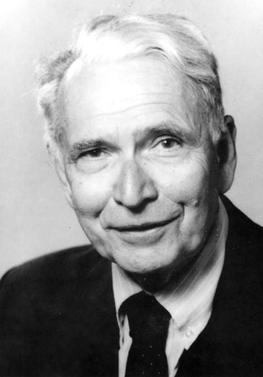
Erwin Chargaff (1905 – 2002)
Erwin Chargaff (1905–2002) was an Austrian-born American biochemist whose research on DNA composition supplied essential evidence for its structure. In 1928, he received his doctorate in chemistry from the University of Vienna. He subsequently pursued research at Yale University, the University of Berlin, and the Pasteur Institute in Paris. In 1933, he left Germany after the Nazi accession to power, and in 1935, he joined Columbia University in New York. Avery, MacLeod, and McCarty’s 1944 identification of DNA as the bacterial transformation substance inspired Chargaff to investigate whether DNA differences among organisms could explain their hereditary specificity.
Chargaff and his colleagues demonstrated that DNA base composition varies among species. Moreover, they showed an approximate molar equivalence of [Adenine] = [Thymine], and [Cytosine] = [Guanine] in what were subsequently called Chargaff’s Rules. This empirically contradicted Levene's tetranucleotide hypothesis of a uniform, 1:1:1:1 repetitive DNA composition. As a biochemist, Chargaff refused to speculate on the biological significance of these results. Such speculation was crucial for Watson and Crick’s modelling of complementary A+T and C+G base pairs within the double helix. Chargaff's autobiographical reflections, Heraclitean Fire (1978), was highly critical of the Watson-Crick approach, and of molecular biology in general, and of genetic engineering in particular.