
Genetic differentiation versus geographical distance in California Sea Lions (Zalophus californianus)
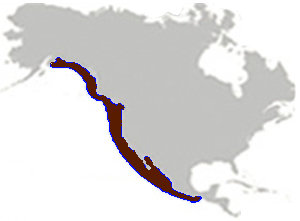
Rookeries (breeding
areas) of California Sea Lions (Zalophus
californianus) are distributed along the
west coast of North America, from Baja California to the
Gulf of Alaska. Sea Lions are members of the family Otariidae ("Eared Seals").
Notice the small external ears, and the forward-direct
hind flippers, which permit limited mobility on land. This
contrasts with "Earless or True Seals" in the family Phocidae, which includes Harp
Seals (Pagophilus groenlandicus).
The first graph plots the Genetic Distance (measured as FST / (1 - FST) between pairs of populations versus their geographic distance. The regression line (solid line) is shown with ±95% confidence interval (dashed lines). FST / (1 - FST) measures genetic distance as genetic differentiation among population (FST) with respect to that among individuals within populations or with respect to the total remainder (1 - [(1 - FIT) / (1 - FIS)]). Note that fractional FST among closer rookeries (< 250 km) varies from 0.005 ~ 0.020, whereas those separated by >1500 km range between 0.03 ~ 0.05. The conclusion is that Sea Lion rookeries show isolation by distance: populations at the northern and southern extremes are the most differentiated.
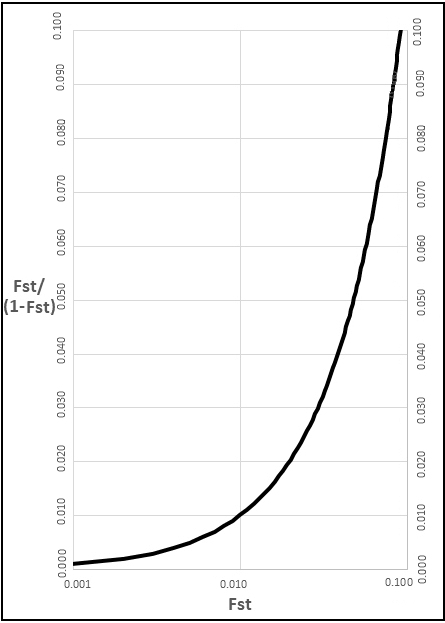
The second graph is a semi-log plot of FST / (1 - FST) versus FST . The observed values of FST / (1 - FST) = 0.01 ~ 0.05 suggests FST = 0.01 ~ 0.05.

The first graph plots the Genetic Distance (measured as FST / (1 - FST) between pairs of populations versus their geographic distance. The regression line (solid line) is shown with ±95% confidence interval (dashed lines). FST / (1 - FST) measures genetic distance as genetic differentiation among population (FST) with respect to that among individuals within populations or with respect to the total remainder (1 - [(1 - FIT) / (1 - FIS)]). Note that fractional FST among closer rookeries (< 250 km) varies from 0.005 ~ 0.020, whereas those separated by >1500 km range between 0.03 ~ 0.05. The conclusion is that Sea Lion rookeries show isolation by distance: populations at the northern and southern extremes are the most differentiated.
The second graph is a semi-log plot of FST / (1 - FST) versus FST . The observed values of FST / (1 - FST) = 0.01 ~ 0.05 suggests FST = 0.01 ~ 0.05.
Figures ©2013 by Sinauer; Graph & Text material © 2025 by Steven M. Carr